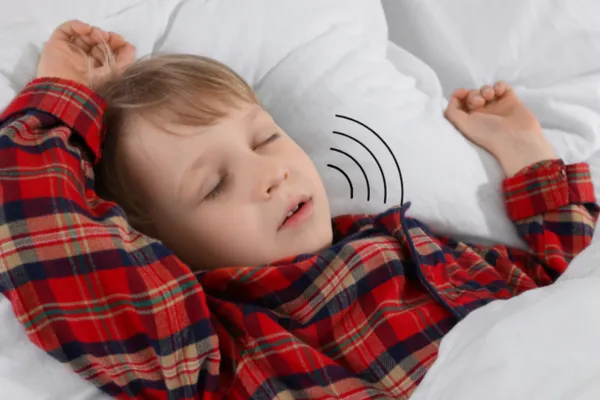
Your Child's Snoring Isn't Cute—It's a Red Flag (Here's What May Be Happening)
Your Child's Snoring Isn't Cute—It's a Red Flag (Here's What May Be Happening)
It's 2 AM.
You wake up to a sound coming from your child's room.
Not crying. Not a nightmare.
Snoring.
Maybe it's soft. Maybe it's loud enough to hear from down the hall.
Maybe you've mentioned it to your pediatrician and heard:
"Kids snore sometimes. It's normal."
"They'll grow out of it."
"As long as they're sleeping, it's fine."
Maybe you've even thought:"It's kind of cute."
Here's what I need you to understand:
Children should not snore.
Not occasionally. Not softly. Not "just when they have a cold."
Snoring in children often indicates that something may be restricting their airway during sleep.
And that restriction can affect everything—sleep quality, development, behavior, health, their ability to thrive.
Let me explain what may be happening when your child snores, why it matters, and what you can explore.
The Snoring Everyone Dismisses
Parents tell me things like:
"My 6-year-old has snored since he was a toddler. The doctor says it's normal."
"My daughter snores so loud I can hear her from down the hall. But she's 'sleeping,' so I thought it was fine."
"I've mentioned snoring at every well visit. Nobody seemed concerned."
"My child wakes up exhausted every morning despite sleeping 11 hours. The doctor says as long as they're in bed that long, they're fine."
If this sounds familiar, I want you to know:
Your concern is valid.
There may be more to this than you've been told.
And there are things you can explore.
What Most Doctors Don't Tell You About Childhood Snoring
When you mention snoring, you typically hear:
"It's normal."
"Try a humidifier."
"Probably allergies."
"They'll grow out of it."
Maybe you get referred to an ENT who checks for enlarged tonsils.
But here's what's often not discussed:
Research suggests that even mild snoring in children may be associated with:
→ Learning and focus challenges
→ Behavioral struggles and emotional regulation difficulties
→ Patterns that overlap with ADHD symptoms
→ Disrupted growth hormone release (which happens during deep sleep)
→ Bedwetting (hormone disruption)
→ Weakened immune function
→ Mood concerns
Why don't doctors mention this?
Because many pediatricians were trained that snoring only matters if it progresses to severe sleep apnea (complete pauses in breathing).
But research has shifted.
We now understand that any level of snoring in children may indicate some degree of airway restriction.
And even "mild" restriction can disrupt sleep quality, oxygen delivery, and healthy development.
You don't need to wait for severe sleep apnea to explore what's happening.
What Snoring May Mean
Let's talk about what may be happening when your child snores.
In healthy sleep (no snoring):
→ Air flows silently through nose and throat
→ Brain cycles through all sleep stages properly
→ Oxygen levels stay optimal
→ Growth hormone releases during deep sleep
→ Brain consolidates learning and memory
→ Child wakes refreshed
When a child snores:
Snoring is the sound of turbulent airflow—what happens when air is forced through a narrowed space.
Something may be partially obstructing the airway: enlarged adenoids or tonsils, a narrow passage, tongue position, inflamed tissues.
But here's what you can't hear:
The brain may be partially rousing dozens—sometimes hundreds—of times per night to manage the breathing challenge.
These are called micro-arousals. Your child doesn't fully wake (so you think they're "sleeping fine"), but their brain may not be reaching the deep, restorative sleep it needs.
The result may include:
→ Fragmented sleep quality
→ Reduced oxygen delivery
→ Disrupted hormone release
→ Compromised immune function
→ Emotional regulation challenges
→ Behavioral and focus issues
Your child might be "asleep" for 10 hours. But they may not be getting restorative sleep.
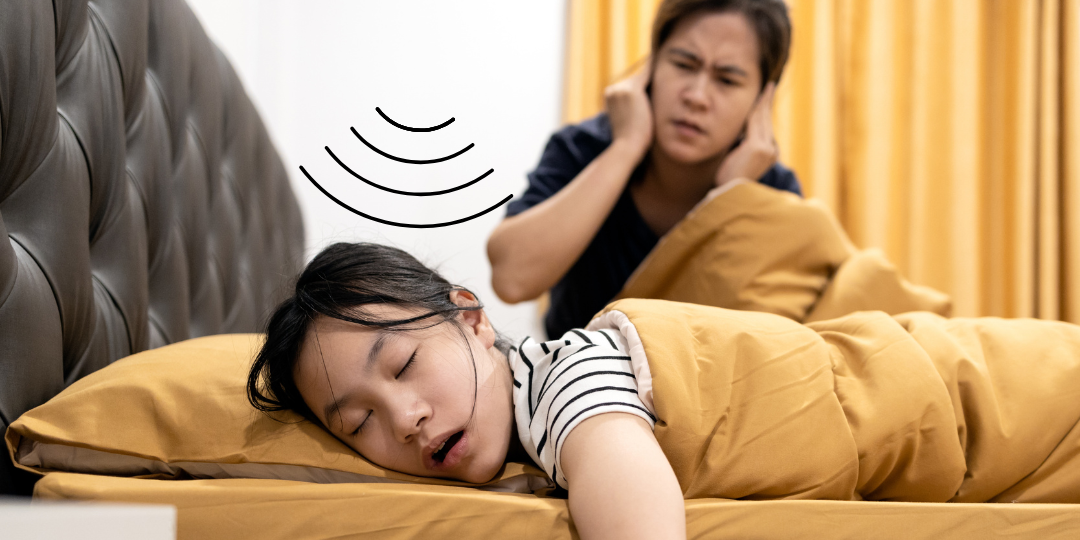
If This Sounds Like Your Child, Trust Your Intuition
→ Book a free 15-minute call right now. Let's talk about what you're seeing
The Pattern Parents Miss
Here's what makes childhood snoring so tricky:
Most parents focus on snoring and don't realize it may be connected to everything else.
Does your child snore AND:
During sleep:
✓ Restless sleep (tossing, turning)
✓ Unusual sleeping positions
✓ Teeth grinding
✓ Mouth breathing
✓ Night sweats
✓ Bedwetting
In the morning:
✓ Waking exhausted
✓ Cranky, irritable
✓ Hard to wake
✓ Morning headaches
✓ Bad breath
During the day:
✓ Dark circles
✓ Chronic fatigue OR hyperactivity
✓ Focus struggles
✓ Emotional meltdowns
✓ Behavioral challenges
✓ Falling asleep in car or during quiet time
Physical signs:
✓ Frequent illnesses
✓ Smaller than peers
✓ Chronic congestion
✓ Frequent ear infections
✓ Long, narrow face
✓ Crowded teeth
✓ Mouth hanging open during day
If your child snores AND has multiple signs from this list, they may all be connected.
The snoring may be the audible clue that the airway function needs support.
Everything else may be what happens when a child's brain and body don't get the oxygen and restorative sleep they need.
What May Be Contributing to Snoring in Children
Something may be making it harder for your child to breathe well during sleep:
1. Enlarged Adenoids or Tonsils
This is often a factor in childhood snoring.
When these tissues are enlarged—from chronic inflammation, mouth breathing, repeated infections, or immune activation—they can physically narrow the airway.
When a child lies down, gravity can make this even more restrictive.
Important: Even if these are removed, if underlying airway structure is narrow or mouth breathing continues, snoring may persist.
You often need to address both structure AND function.
2. Narrow Nasal Passages
Some children have structurally narrow nasal passages—often connected to underdeveloped upper jaw growth.
Here's a common pattern:
Child can't breathe well through nose → mouth breathes to compensate → tongue drops down instead of resting on palate → without tongue pressure, upper jaw doesn't expand properly → narrow jaw = narrow nasal passages = continued breathing challenges → pattern continues.
Why timing matters:
During growth years (roughly ages 3-12, especially 5-10), facial bones are still developing and responsive.
If we support proper development early, we may be able to create more space for airflow.
After growth plates close (around 12-13), structural changes become much harder.
3. Tongue Position During Sleep
The tongue plays a significant role.
What should happen: Tongue rests on roof of mouth during sleep, keeping it forward and airway open.
What often happens instead: If a child has low tongue tone, restricted movement (tongue tie), has been mouth breathing, or has a narrow palate, the tongue may fall backward during sleep.
This can partially block the airway.
Addressing this may require:
→ Releasing tongue ties (if present)
→ Myofunctional therapy (retraining tongue posture)
→ Nasal breathing support
→ Sometimes palate expansion
4. Chronic Congestion
If your child has chronic congestion—from allergies, food sensitivities, or inflammation—they may not be able to breathe well through their nose.
So they mouth breathe.
And when the mouth hangs open during sleep, the tongue drops, the airway narrows, air turbulence increases.
The key: You can address allergies and reduce inflammation.
But if nasal passages are structurally narrow, or tongue posture needs support, or adenoids are enlarged, congestion isn't the only factor.
This is a "both/and" approach: Inflammation matters. Structure matters. Function matters.
Comprehensive support often means addressing all three.
Why "They'll Grow Out of It" May Not Be the Best Plan
Many pediatricians suggest waiting.
Here's what may happen while you're waiting:
Your child may experience:
→ Daily exhaustion masked as hyperactivity
→ Behavioral challenges at home and school
→ Academic struggles
→ Social difficulties
→ Emotional dysregulation
The underlying pattern may continue:
→ Airway restriction persists
→ Facial development proceeds in narrow patterns
→ Sleep deprivation compounds
→ Growth may be affected
→ Immune function may weaken
→ Pattern becomes more established
Some children do eventually stop snoring as they grow.
But that's hoping natural development compensates for underlying dysfunction.
Meanwhile, your child may be losing years of optimal sleep, learning, and development.
Early awareness and support often means gentler, more effective options.
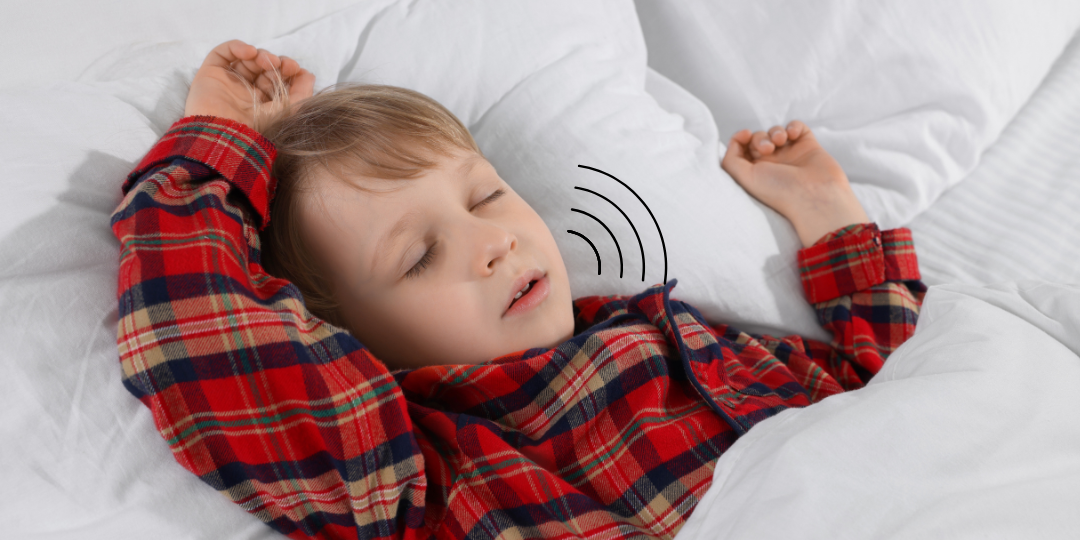
"But Snoring Runs in My Family"
If you snored as a child, or your partner snores, there's a good chance your child inherited similar structural patterns—narrow airways, enlarged tissues, tongue restrictions.
But here's the difference:
You may not have known this was addressable. Nobody may have told you what to look for.
Your child doesn't have to repeat that pattern.
You can explore support now, while they're still growing and structures are responsive.
"Wait... I Snore Too. Can This Help Adults?"
Here's something parents quietly tell me:
"I've been so focused on my child's snoring... but I snore too. And I wake up exhausted. And I grind my teeth. And I have TMJ pain."
If you're seeing these patterns in your child AND recognizing them in yourself, you're not alone.
Airway restriction, mouth breathing, poor sleep quality—these don't magically resolve in adulthood.
They compound.
Adults benefit from the same airway and myofunctional support children do:
→ Improved sleep quality
→ Reduced or eliminated snoring
→ Less teeth grinding and TMJ pain
→ Better energy and focus
→ Reduced headaches
→ More restorative sleep
→ Relief from chronic neck and shoulder tension
Many adults have struggled with these patterns for decades—never realizing they were connected to airway function and breathing.
If you're interested in exploring support for yourself alongside your child, mention it when you book your FREE clarity call.
Often, addressing family patterns together creates better outcomes for everyone.
Because when the whole family sleeps better and breathes better, everything improves.
What You Can Do If Your Child Snores
Tonight: Observe
Check on your child 30-60 minutes after they fall asleep:
→ Mouth open or closed?
→ Any sounds?
→ What position?
→ Restless or peaceful?
→ Grinding teeth?
Check again in the middle of the night. You're looking for patterns.
This Week: Notice Daytime Patterns
→ How do they wake up?
→ Dark circles?
→ Energy levels?
→ Behavior patterns?
→ How often do they get sick?
→ Mouth hanging open during day?
Don't Accept "It's Normal" Without Exploring Further
If your pediatrician dismisses the snoring, consider asking for:
→ Referral to an ENT who understands pediatric airway
→ Pediatric sleep specialist
→ Biological dentist trained in airway-focused care
→ Myofunctional therapist
Or work with a practitioner who specializes in comprehensive pediatric airway assessment.

How I Help Families Understand What's Happening
As a specialist in airway and oral development, I help families explore factors that may be contributing to snoring:
→ Breathing patterns (day and night)
→ Oral structure and function
→ Tongue tie, lip tie, buccal tie evaluation
→ Facial development patterns
→ Signs of sleep disruption
→ How everything may be connected
I don't diagnose or treat medical conditions.
I help families understand patterns, connect dots, and create a plan that may include:
→ Working with trusted ENTs, dentists, and therapists
→ Tongue tie release (if present and appropriate)
→ Myofunctional therapy to support breathing and oral function
→ Addressing inflammation triggers
→ Palate expansion (during growth years when indicated)
→ Breathing retraining
→ Sleep optimization support
I guide you through exploring options and coordinating care.
And if you're recognizing these patterns in yourself as well as your child, we can discuss family-centered support.
Let's Talk
Book a free 15-Minute Thriving Kids Clarity Call.
We'll discuss:
→ Your child's snoring pattern
→ What you're seeing with sleep and behavior
→ What factors may be contributing
→ Whether a comprehensive assessment makes sense
→ Support options for other family members (if relevant)
→ Your questions
No pressure. No pitch.
Just real conversation about your child—and your family.
Because dismissing snoring as "cute" or "normal" when your intuition says something's off isn't a plan.
Understanding what may be happening is.
BOOK YOUR FREE CALL - LET'S GET TO THE WHY
Questions Parents Ask Me
"Is it ever normal for children to snore?"
Unlike adults (where snoring is common though problematic), children typically shouldn't snore. Any snoring in children may indicate some level of airway restriction and is worth exploring.
"My child only snores when they have a cold. Should I worry?"
Occasional snoring during acute illness can happen. But if your child snores every time they're congested, or if snoring continues after illness resolves, there may be an underlying airway pattern being revealed. Worth exploring.
"Can allergies cause snoring?"
Allergies can contribute by causing congestion and inflammation. But allergies alone rarely explain persistent snoring. Usually there's also a structural or functional component. Both may need support.
"My pediatrician says it's not severe enough to worry about."
Research suggests that even "mild" snoring in children may be associated with developmental and behavioral challenges. You don't need to wait for severe sleep apnea to explore what's happening. If your child snores regularly and shows signs of sleep disruption, seeking evaluation from someone who specializes in pediatric airway may be helpful.
"Will my child need tonsils and adenoids removed?"
Not necessarily. Some children do need removal if tissues are severely enlarged. But often, addressing inflammation triggers (like dairy sensitivity) can help tissues reduce naturally. And even if removal is appropriate, underlying airway structure and oral function often still need support.
"Can a tongue tie contribute to snoring?"
Yes. When tongue movement is restricted, it may not rest properly and can be more likely to fall back during sleep. Tongue ties can also contribute to mouth breathing and affect palate development—all of which may impact airway function.
"My child snores and has ADHD symptoms. Could these be related?"
Research suggests that sleep disruption from breathing challenges can manifest in children as hyperactivity, impulsivity, focus struggles, and emotional dysregulation—patterns that overlap with ADHD. When sleep quality improves, these patterns often improve significantly.
"Can adults benefit from this work too?"
Absolutely. Many adults have struggled for years with snoring, poor sleep, teeth grinding, TMJ pain, headaches, and chronic exhaustion—never realizing these were connected to airway function and breathing patterns. Adults benefit from airway assessment and myofunctional therapy. If you're recognizing yourself in these descriptions, mention it during your clarity call.
"How long until we see changes?"
This varies. Some families notice shifts within weeks (addressing inflammation, starting breathing exercises). Others see gradual improvement over months (tongue tie release with therapy, palate expansion). Most families notice at least some positive changes relatively quickly.
Share This With Another Parent
If this helped you understand that childhood snoring may indicate more than you were told, you probably know another parent who needs this information.
Send it to them.
Text. Email. Mom group.
Sometimes one article changes a child's trajectory.
About Nichole
I'm a Traditional Naturopathic Practitioner and Airway & Oral Development Specialist.
I help families understand what may be behind snoring, disrupted sleep, and the behavioral and developmental patterns that often follow.
I work with children and adults—because airway dysfunction and oral function patterns often run in families, and supporting the whole family often creates better outcomes.
Specialties:
→ Pediatric airway dysfunction patterns
→ Adult airway and sleep support
→ Tongue ties, lip ties, buccal ties
→ Myofunctional therapy
→ Sleep-disordered breathing
If your child snores (or you do too) and you know something more may be happening—I'm here to help you explore it.
Enjoyed this article?
We regularly share additional tips, quick strategies, and real examples on our social media.
📲 Follow us to keep learning and stay ahead.
Contact email: [email protected]
Facebook™ page: Naturopath Nichole
Instagram page: Nichole Apperson
With Love, Nichole 🦚
Helping children breathe freely, function optimally, and thrive fully.

