What Is Myofunctional Therapy for Kids? The Missing Link Between Your Child's Sleep, Behavior, and Development
What Is Myofunctional Therapy for Kids? The Missing Link Between Your Child's Sleep, Behavior, and Development
Here's a question most parents have never been asked:
When your child is relaxed — watching TV, doing homework, falling asleep — is their mouth open or closed?
Don't answer yet. Go look. I'll wait
If you just realized their mouth hangs open… you're not alone. Most parents have never noticed. Not because they're not paying attention. But because no one ever told them it mattered.
Here's what else you've probably never been told:
→ The way your child breathes shapes their face. → Where their tongue rests affects how their teeth come in. → Mouth breathing during sleep means their brain never fully rests. → "Picky eating" is often an oral function issue, not a behavior issue. → Orthodontic results don't hold if the tongue keeps pushing teeth back out of place.
And here's the kicker...None of this gets better on its own. Your child doesn't "grow out of" mouth breathing. They adapt. And those adaptations quietly become structure, sleep disruption, crowded teeth, speech delays, focus struggles, and behavioral challenges that everyone blames on everything else.
That's where myofunctional therapy comes in. And if you've never heard of it? You're about to understand why your child might desperately need it.

What Is Myofunctional Therapy? (And Why Didn't Anyone Mention This Sooner?)
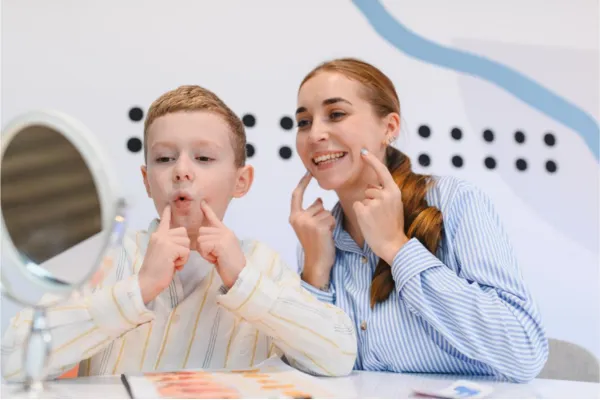
Think of it as physical therapy for the mouth and face. Myofunctional therapy retrains the muscles of the tongue, lips, jaw, and face to support:
Proper breathing (through the nose, not the mouth)
Correct swallowing patterns
Optimal tongue posture
Stable facial and airway development
Better sleep, speech, focus, and behavior
It's not about making your child "better at eating" or "less fidgety." It's about fixing the foundation so everything else can actually work. Here's what most parents don't realize...
Structure without function doesn't last.
You can release tongue ties, expand narrow palates, straighten crowded teeth...but if you don't retrain the muscles? The body reverts. The teeth shift back. The airway stays restricted. The sleep stays disrupted. Myofunctional therapy is what makes everything else stick.
The Moment Most Parents Realize Something's Off
It usually goes like this...
A mom mentions her child snores.
Or grinds their teeth at night.
Or has dark circles under their eyes despite "sleeping through the night."
Or struggles with certain speech sounds even after months of speech therapy.
Or had a tongue tie released… but nothing really changed.
And someone — a dentist, an ENT, a sleep specialist, or (often) another mom — says, "Have you looked into myofunctional therapy?" And the mom thinks:"Myo-what?"
Then she starts noticing...
Her child's mouth doesn't stay closed at rest.
Their breathing sounds different when they're asleep
They're always congested
Orthodontics feels like it's going in circles
Feeding is still a battle
And suddenly she can't unsee it.
If that's you right now? Keep reading.
Why This Matters So Much in Childhood (And Why "Wait and See" Doesn't Work)
Here's the part no one explains clearly: The tongue plays a massive role in shaping the face and airway. Where your child's tongue rests — especially during critical growth years — directly affects:
→ palate width (narrow vs. broad) → nasal airway size (restricted vs. open) → facial growth direction (long/downward vs. forward/broad) → space for teeth (crowded vs. aligned) → airway stability during sleep (collapsed vs. supported)
A tongue that rests UP on the palate supports:
Broad, forward facial growth
Easier nasal breathing
Naturally aligned teeth
Stable airways during sleep
A tongue that rests LOW in the mouth creates:
narrow palates
crowded teeth
long, downward facial growth
restricted airways
chronic mouth breathing
disrupted sleep (even if they "sleep through the night")
Children don't grow out of this. They grow INTO it. Those compensations become structure. And by the time most parents are told about it? Years of critical development have already passed. That's why I'm telling you now.
Tongue Tie Release Without Myofunctional Therapy? You're Only Halfway There.
If your child has had — or is considering — a tongue, lip, or buccal tie release, listen carefully. Releasing the tie is only half the story. The release removes the restriction. But it does NOT automatically:
strengthen weak tongue muscles
retrain compensatory swallowing patterns
correct low resting tongue posture
prevent reattachment
That's why experienced providers require pre- and post-release myofunctional therapy. Not because they're being difficult. Because they've seen what happens when it's skipped:
→ Ties reattach → Function doesn't improve → Parents feel frustrated and misled → Kids still struggle
A released tie without retraining is like cutting a cast off a broken bone without rehab. You removed the restriction. But the muscles still don't know how to work properly. Myofunctional therapy teaches them how.
Does My Child Need Myofunctional Therapy? (Probably Yes If You're Still Reading)
Your child may benefit from myofunctional therapy if they:
breathe through their mouth (day or night)
snore, even quietly or occasionally
sleep restlessly (tossing, turning, odd positions)
grind or clench their teeth
had a tongue, lip, or buccal tie released
have a narrow palate or crowded teeth
struggle with certain speech sounds
are extremely picky with food textures
used a pacifier or sucked their thumb long-term
are in or heading toward orthodontic treatment
have dark circles under their eyes
wet the bed past age 5
seem "always tired but wired"
struggle with focus or emotional regulation
If you checked more than 2… keep reading.
What Does Myofunctional Therapy Actually Look Like?
Most pediatric programs include:
→ Short daily exercises (10–15 minutes) → Weekly or bi-weekly sessions with a myofunctional therapist → Habit retraining (breathing, swallowing, tongue posture) → Parent involvement (because consistency = results)
The real work happens at home. But when parents understand WHY it matters? Consistency improves dramatically. Because kids do better when their bodies feel better.
Myofunctional Therapy Results: What Parents Actually Notice
When therapy is done consistently, parents report amazing results!
Breathing & Sleep:
Less mouth breathing
Deeper, more restful sleep
Reduced snoring and teeth grinding
Development & Function:
Clearer speech
Better chewing and food tolerance
Improved focus and emotional regulation
Orthodontic results that actually hold
And here's the quiet part many parents notice, "As my child improved, I realized I struggle with some of these things too." Poor sleep. Jaw tension. Headaches. Mouth breathing. Teeth grinding. These patterns often persist into adulthood when they were never addressed in childhood. Supporting your child often brings awareness to where you may deserve support too.
How I Work With Families (Because Strategy > More Appointments)
When I evaluate a child, I look at:
→ Airway → Oral function → Sleep quality → Growth patterns → Habits → How everything connects
From there, I help families create a clear, coordinated plan — not a scattered one. Because children don't need more appointments. They need better strategy.
Ready to Get Clarity on Whether Your Child Needs This?
If you're reading this thinking"Okay… this is my kid"— I invite you to schedule a FREE 15-Minute Thriving Kids Clarity Call.
No pressure. No sales pitch. Just clarity. We'll talk through:
What you're seeing
What I'd look at first
Whether myofunctional therapy makes sense for your child
Schedule Your Free 15-Minute Thriving Kids Clarity Call
One Small Ask That Could Change Another Child's Life
If this article made you go "OH. That's what's happening"— here's my challenge:
Think of 3 parents whose child snores or sleeps restlessly, struggles with speech, feeding, or orthodontics, had a tongue tie release but didn't fully improve, mouth breathes, has behavioral or focus struggles no one can explain
Now do one thing...Text them this article. Email it. Share it in your mom group. Save it for later. You don't need to explain it perfectly. Just say:"This made me think of you." Sometimes that's enough to change a child's trajectory.
Pro tip: If this resonates but now isn't the right time, bookmark this. Many parents return months later — usually when "waiting it out" didn't work.
Myofunctional Therapy FAQs
Will my child actually do the exercises? Yes — especially when exercises are short, consistent, and built into daily routines.
How long does myofunctional therapy take? Most programs last 4–12 months depending on age, severity, and consistency.
Do we still need therapy if we're doing palate expansion? Yes. Expansion creates space; therapy teaches the tongue how to support it.
Can parents benefit from myofunctional therapy too? Absolutely. Adults often benefit for mouth breathing, teeth grinding, TMJ tension, headaches, orthodontic relapse, and poor sleep.
About Nichole Apperson
I'm a Traditional Naturopathic Practitioner and Airway & Oral Development Specialist who helps families understand the WHY behind children's sleep, breathing, feeding, and developmental struggles.
I specialize in pediatric airway dysfunction, oral restrictions, and care that addresses both structure and function.
Contact: [email protected]
Book a Free Kids Clarity Call
If you have any other general questions regarding this topic don't hesitate to contact me!
This is just the beginning.
I share more tips, resources, and real-world examples about this topic on our social media.
👉 Follow me on Faceboook, Instagram and TikTok so you don’t miss the next insights.
With Love, Nichole 🦚
Helping children breathe freely, function optimally, and thrive fully.

